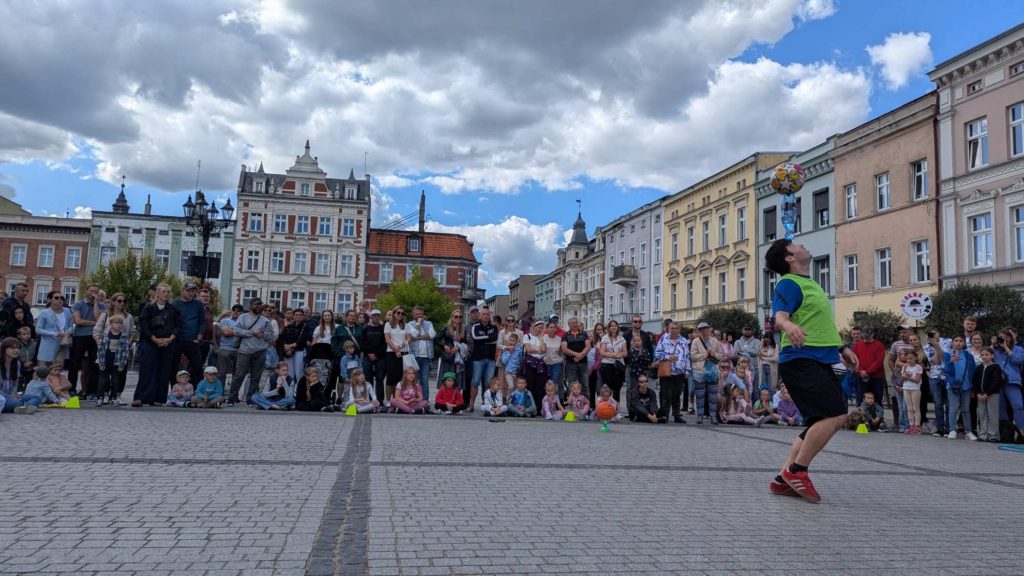
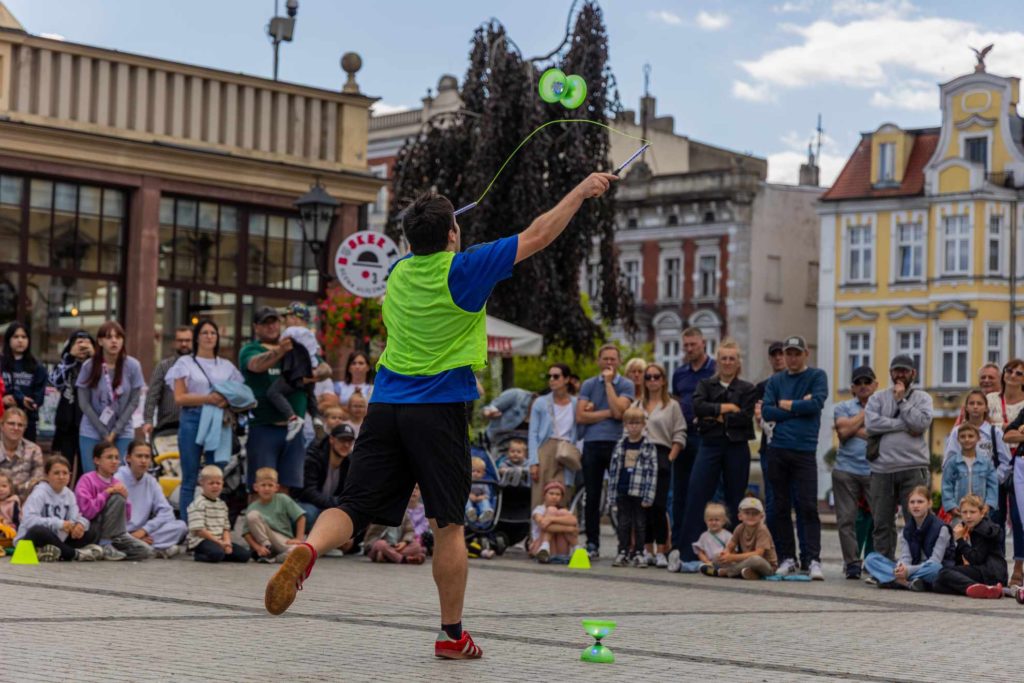
Street performer Stefan Florescu at Busker Tour festival in Krotoszyn photo by Joanna Dryjańska-Pluta
Over the last few months, we have been chatting with Stefan Florescu about various busking and festival-related topics. It was time to organise our ideas and tips and share them with you.
From this interview, you can learn more about his story as a street performer, his path to getting into his first busking festivals, and his nomadic life.
We have decided to keep it conversational—as we would if we were still talking privately—so I also share my insights from the perspective of a festival curator and producer.
Małgorzata Węglarz (Busker.pl): How would you describe yourself in a few words?
Stefan Florescu: If I had to describe myself in a few words, I would say that I am very competitive, addicted to performing, I want to be the best, I want to be out of the ordinary, and I have lots of ideas. At the same time, I can be lazy and comfortable sometimes and it helps when I have someone to pressure me to take the right path.
You are good at football tricks, but are you good at playing football? And are you actually a football fan?
When I was a kid, I really wanted to be a football player, but in my hometown, there was only one option – the sports high school. When I arrived there, the football groups were already full, so I had to wait for a year. I decided to go for the running groups in the meantime because I thought it would help with football in the future. I ended up running professionally and was even a silver medallist in my age category in Romania.
Once I failed to qualify for the national championship. I remember my coach really wanted me to qualify, and that morning, he gave me a bunch of vitamins that ended up making me feel sick. I believe it’s one reason that I couldn’t achieve my best in that qualification. I never told him that. He was disappointed, and even though I did my best in practice, he stopped taking me to competitions, so I lost motivation to practice.
I never really played football, but I saw some videos on YouTube with the first generation of freestyle footballers doing crazy tricks. I really thought it was a fake video at that time, but slowly I started to learn easier tricks and I discovered this “sport/art”. To answer your question, I wished to play football, but I never had the chance, and I slowly became a football freestyler.
Now I neither follow football nor support any team.
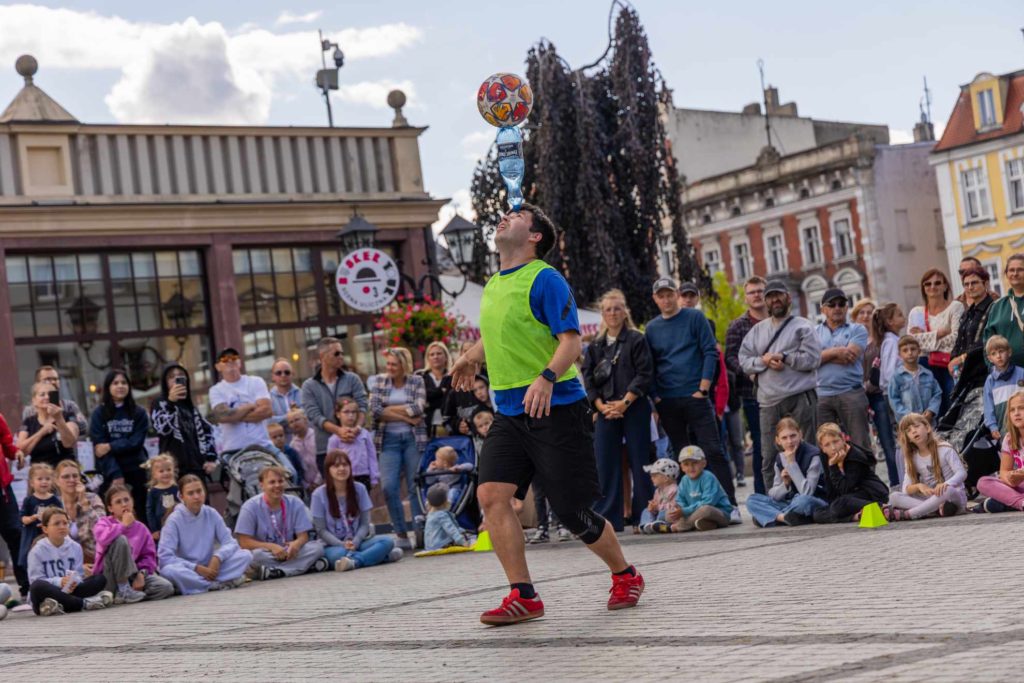
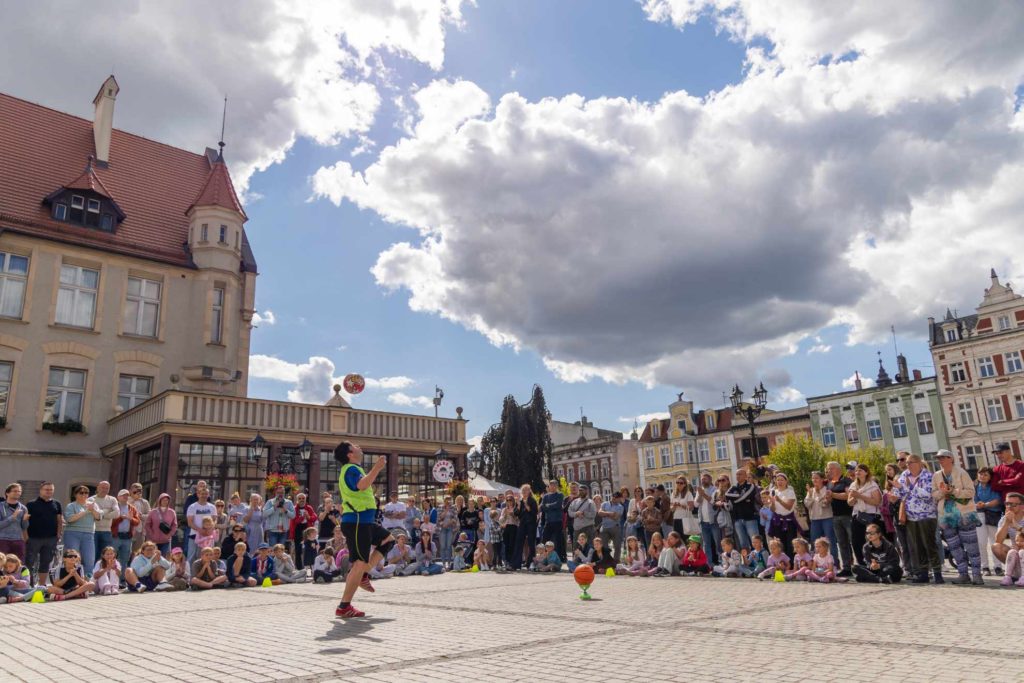
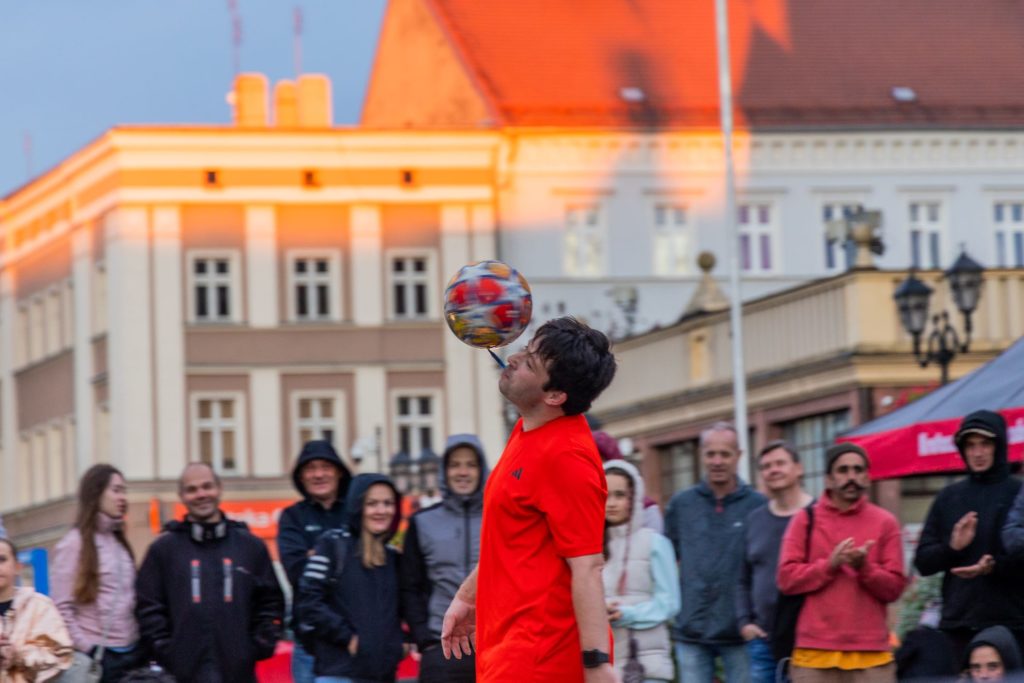
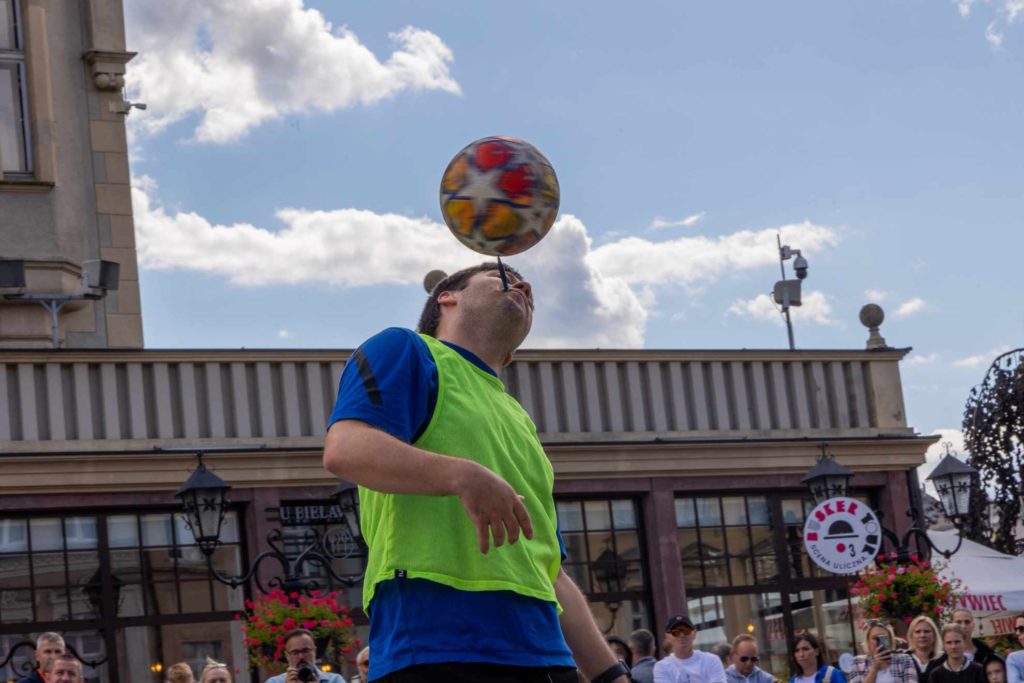
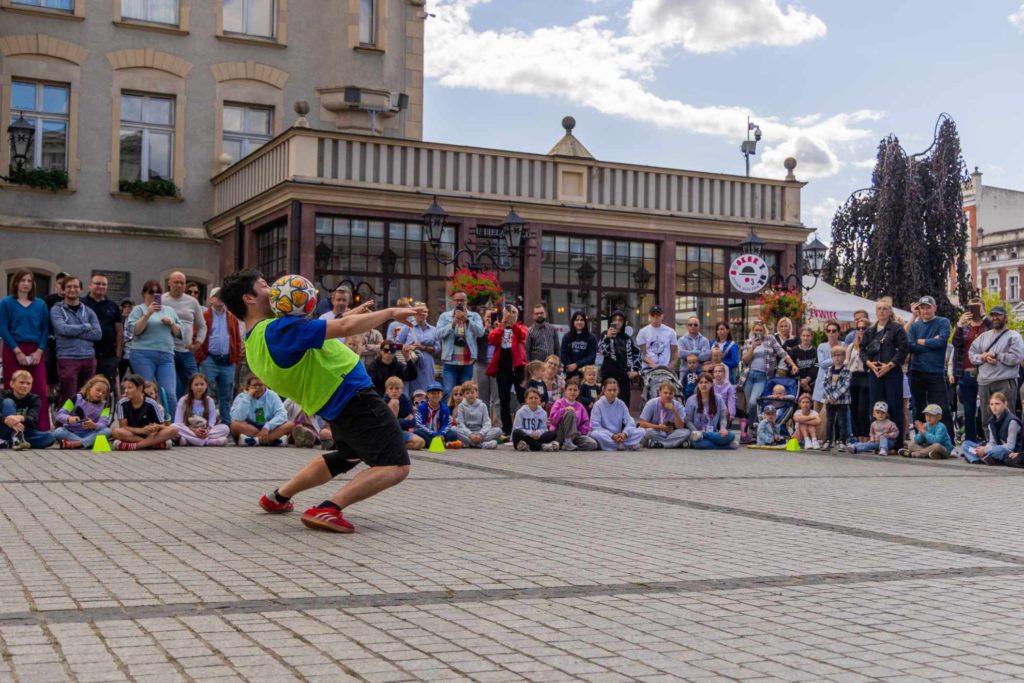
Freestyle football trick by Stefan Florescu at Busker Tour in Krotoszyn, photo by Joanna Dryjańska-Pluta
How did you decide to become a busker, and why do you perform in the street?
In freestyle football, I really enjoyed doing choreography to the music and making it like a show. At that time, the freestyle community was very battle-focused, and choreography and shows were something looked down upon. So I always tried to follow what the community wanted, and I practised things I was not good at instead of what I enjoyed and was actually good at.
Competition was not a reliable way to live out of freestyle football, so I tried to focus more on performing just so I could continue to be a freestyler full-time.
I went to the first season of Romania’s Got Talent and for a while I started to have shows. Like any freestyler in the world at that time, I had a show that was about 3 to 5 minutes long. Every event was looking for longer shows and nobody understood how hard it is for a freestyler to do tricks for longer. Over time, the opportunities to perform became fewer and fewer.
It is worth adding that in the freestyle community, busking is generally considered as a way to practise tricks that are not stable enough or a way to start to control your emotions in front of people before you do stage shows or competitions.
So, the first time I started to busk was in Romania at the seaside in the summer. It was a very beginner-friendly place, because we had no street art at all at that time, the beach in summer is so crowded, and everyone was stopping very fast.
I was just doing tricks with a box for tips in front for a few hours a day. It was nice but the issue was that the summer season was only two and a half months a year and I was not saving money. However, for a 17-year-old teenager, living the whole summer at the seaside was ‘leaving the life’.
From Romania to Amsterdam with 10 euros in a pocket
You won me over with your application for Busker Tour and your bio, “I went to Amsterdam from Romania 48 hours by bus and 10 euros in my pocket. I survived until now :D”.
Have you sent the same bio to other festivals?
I had never sent this bio to any other festival. I remember I had been rejected so many times that I didn’t expect to be accepted anymore. So I just wrote what I was feeling at that time.
Well, I did accept you! I took it as a joke as you mentioned my articles while replying to other questions in this application. So, why Amsterdam?
When the summer was over, I wasn’t earning any money. I lived with my Father and Grandmother, in a village house in the north-east of Romania, near the border with Ukraine. Life was not easy there. My father was sick and not working so we all survived on my Grandmother’s pension. Sometimes we didn’t have electricity for months.
I had to choose, either found a regular job soon or I needed to start earning money from freestyle. Having a regular job hadn’t crossed my mind for even a second. I was going to be a freestyler. But how?
Then I remembered seeing a viral video on YouTube with a freestyler busking in Amsterdam. In my last season of unprofessional busking at the seaside, I saved just enough so I could take a bus to the Netherlands. After buying the bus ticket, I had €10 left in my pocket. That didn’t matter because I knew once I was there I would just leave off the busking money.
If only everything were that easy!
On my first day, I busked for five hours straight with two friends. No breaks at all. At the end of the day, we had €9 to split three ways. Not the best start.
People just didn’t care about us. For the first time I was performing in a place where busking was something normal and people were just weren’t curious about what we were doing. They passed us as if we didn’t even exist.
For the first few weeks, I was not making enough money to pay for any kind of accommodation. In the first week, I found a campsite without security at night, so I would always go there with a tent and leave before the morning shift arrived. After they found me and kicked me out, I slept in a park for a while.
It’s very hard to improve when you are afraid of where you will sleep. Many times I woke up to police flashlights or big dogs smelling me. I was very disappointed. I saw other performers doing real shows with crowds, so I knew it was just me. I eventually arrived in Prague, where everything was much easier. I found cheap accommodation, and when I had no pressure anymore about where I would sleep, I started to improve.
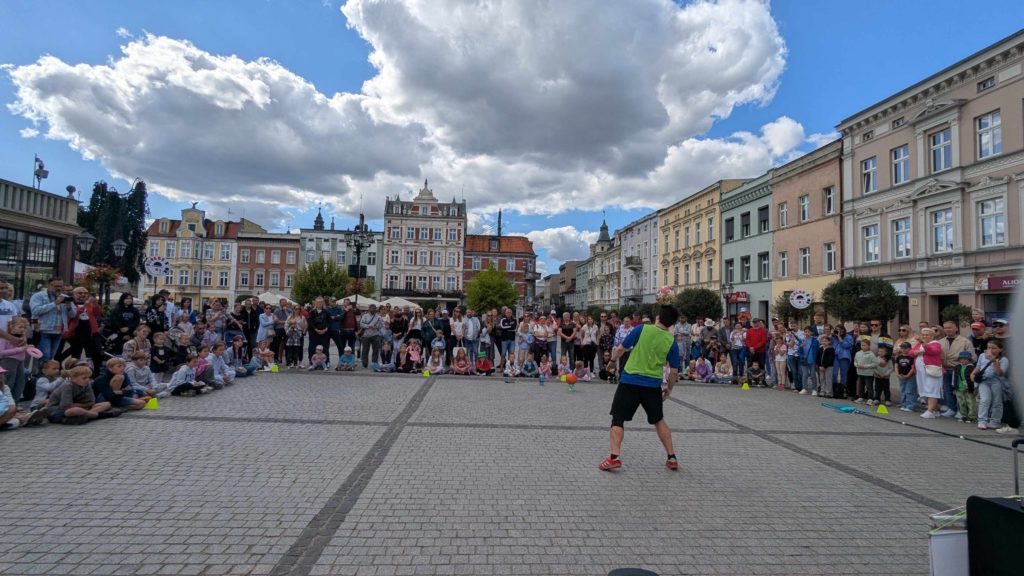
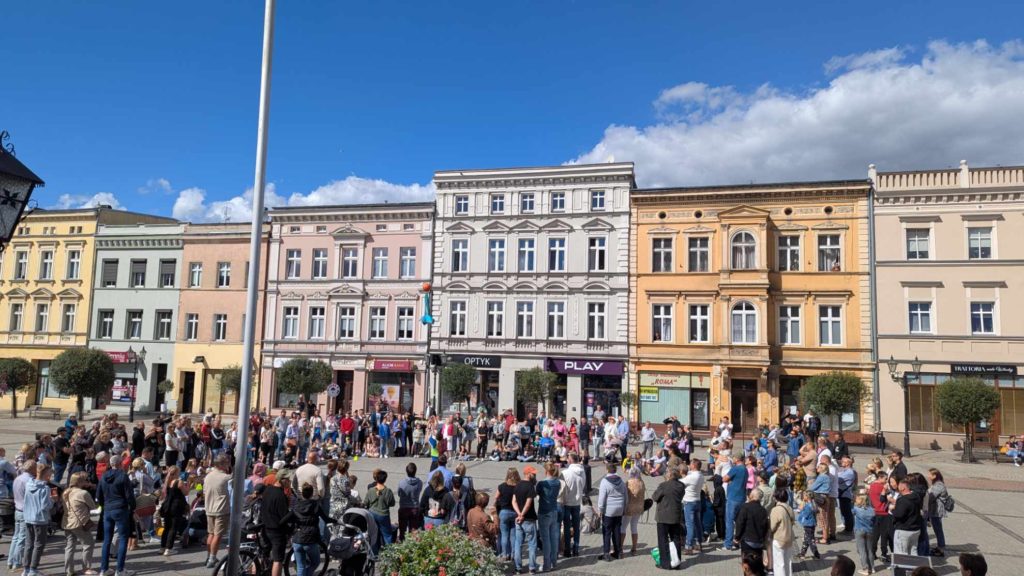
Stefan’s street show at Busker Tour in Krotoszyn. Photo by Joanna Dryjańska-Pluta
We met for the first time a decade ago when your street performance was focused on showcasing football tricks without any show structure. What is your process for developing your show?
When I was performing in Prague, I met Marcin EX. He invited me and another friend to a Polish festival. At that time my show was only about three minutes long. I felt I was out of place there, so for a very long time, I didn’t consider festivals as something I could do.
I think I had a structure, it was just not a match for festivals. I did a lot of non-stop “walking by” busking (with the box in during the entire performers, and without building big crowds. I learned from it that I must stop people first, but because my show was very short, I also had to stop people very fast, so I could repeat the performance multiple times.
This ’s how I developed my ways to stop a crowd very fast. It was going well, but it was very physically challenging because my routine was difficult and I had to do it 20–30 times a day.
I wanted to make my show longer but I didn’t know how. European performers were all telling me I needed to talk more and to make jokes. It wasn’t something I liked to do. At the time, there was no other freestyler in the world doing a long show, so there was nowhere to take inspiration from.
One of my videos went viral on Facebook, and the country where the most views came from was the Philippines. I wanted to visit for this reason, and one of my friends was interested in visiting Taiwan, as he had heard it could be good for shows.
We went to both places together in 2017. When I arrived in Taiwan, I saw that buskers there had a totally different way of doing street shows. One much closer to the style I liked. They were doing 15–20 minute shows. No talking, just a strong gathering, energy buildup and a routine with strong skills. In Taiwan, I started to change again, and I made my show about 15 minutes long.
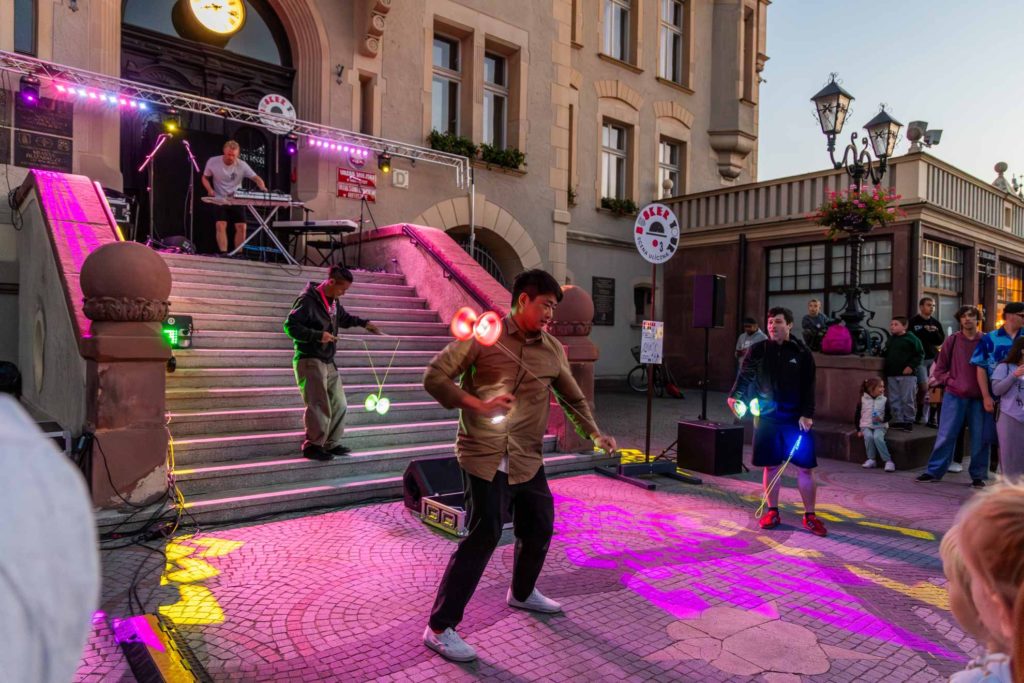
Performers jam at Busker Tour 2025 in Krotoszyn. ChéRebel, CHINNEN, Wu Haw Jong and Stefan. Photo Joanna Dryjańska-Pluta
You learnt diabolo from our friend Wu Haw Jong, shoutout to him! Why diabolo?
When the COVID pandemic started, I was in Taiwan. At that time, we heard many rumours about how deadly it could be, and my wife and I decided to go quickly to Romania because I was expecting to get stuck in Taiwan.
The first year of the pandemic was very depressing. I remember when the army was patrolling the streets, and I needed to fill in a form just to go to the shops. I was not allowed to go to the park to practise, so I was always in the house playing video games. I gained about 10kg during that time.
In the following summer, when the restrictions became a bit more relaxed, I started to perform again. These were mostly weird shows where I had to wear a mask while doing physical activity, and organise the crowd, so that every person was one metre apart. The police told me that it was my responsibility to make my audience wear masks even though the law at the time was that it wasn’t necessary in the open air. Still, at least I was able to perform.
Summer passed, and with autumn the second big wave of COVID came. This time I wasn’t going to just stay in the house doing nothing like the first time. I didn’t want to let this time become a few lost months of my life. I bought a big metal cube to start practising for a new show, but then one of my friends told me: “You took inspiration from Taiwan, why don’t you try to learn cube and not the diabolo? The Taiwanese are the best diabolo players out there. Use this opportunity.”
I realised he was right. I started to practise the diabolo instead. I instantly loved it. In my opinion it had many similarities to freestyle football. The best part was that, unlike freestyle, which is very physically demanding, diabolo was not. I could practise for many hours at a time until I got tired.
For the next few months, I was practising diabolo while learning mostly from YouTube tutorials. When I posted my first video on Instagram, I remember one message was from Wu Haw Jong. He was one of the performers who really motivated me to continue with the diabolo with his positive comments and mindset.
Yes, he helped me with advice when I asked him, but the biggest help was his positive energy. He knew how to make a beginner want to train even harder.
I know, I have had a chance to experience that! He explains things with enthusiasm and patience. I cannot wait for another lesson from both of you! After our class, I asked for a diabolo for my birthday. Wu Haw Jong helped me choose one, so I am ready for the next practice!
One of the most fun experiences on Busker Tour was after the shows were over and we all played and practised together. I definitely would like to do that again. A few more Busker Tours and you will be performing as well!
By the way, just hypothetically, if we told you that from now on, you must become a performer instead of an organiser, what show would you choose to do? What equipment (one or multiple) and why? I want to know what you would like to do but also what you would choose because it makes sense technically or creates bigger crowds, or helps the show in other ways. Good Luck!
Music has always been my number one passion. Not a performer, but I have always wanted to be a songwriter for other people. This is a dream I would actually like to work on fulfilling.
In this hypothetical scenario, when I am a performer, I would be singing on a pitch by the river my sad original songs and playing guitar for the one or two people they would resonate with. And I would ask drunk people their stories and sing improvised songs for them filled with compliments.
Everyone says juggling is easy, but I somehow cannot get how it works. I have tried many times, and each time I feel like my brain cannot comprehend the idea of three-ball juggling.
There would be no fire either, as I am not a fan of fire shows. I book them only for the audience.
I like technical skills. Shoutout to Sam Goodburn because unicycling on a tightrope is the most memorable trick I have seen. I have not tried it (yet!). So far, even walking on a slackline 3 cm above the ground makes me feel like I’m afraid of heights.
I tried cube manipulation with Chien Hung, and I loved it. And I have always wanted to learn how to do a backflip!
There would be no spoken jokes or clownery in my show.
To summarise:
A lyrical (Asian-style) circus and music show performed in a beautiful dress.
Like in a musical theatre, the lyrics of my original songs in the background would guide the narration. There would also be live music—improvised songs created together with the crowd, humming and singing along. Cube manipulation and backflips. Some acrobatic stunts would start on high objects available on the pitch, like a bench or a table.
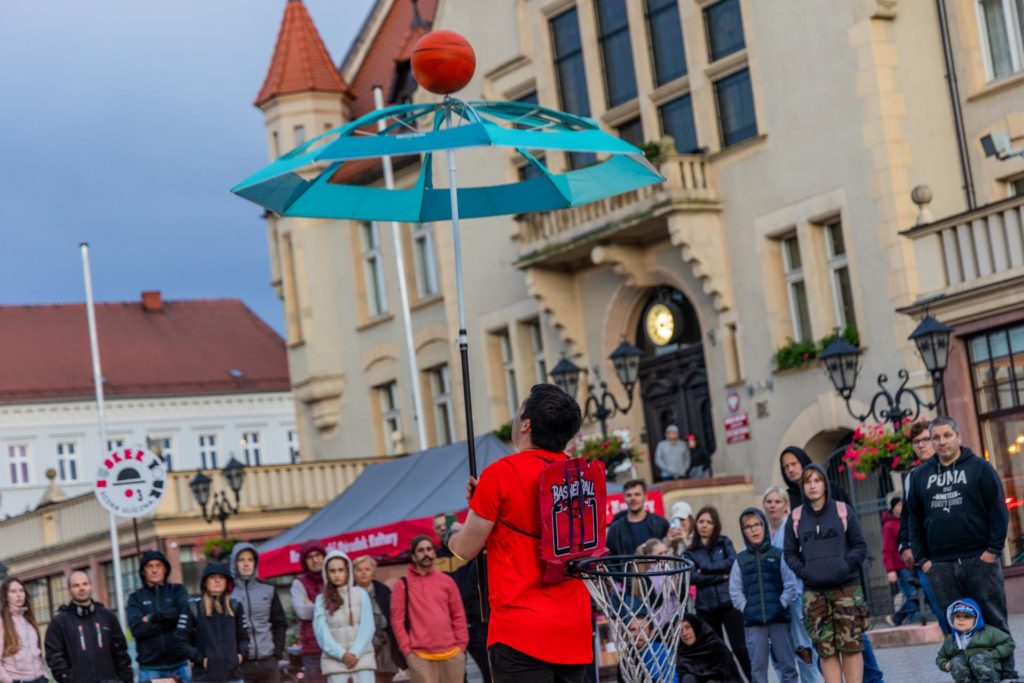
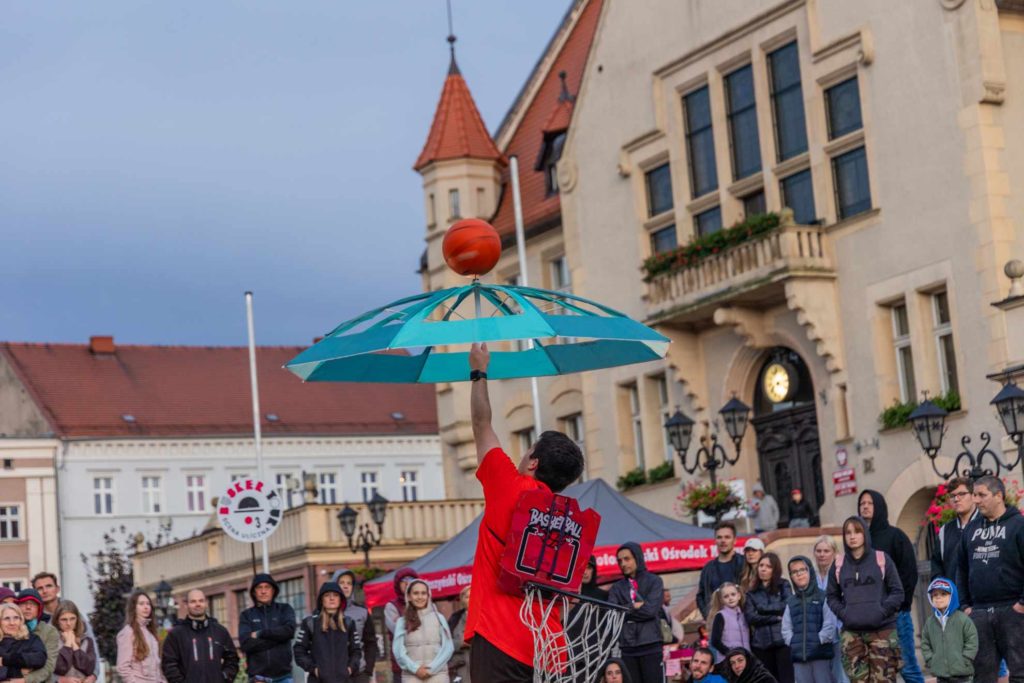
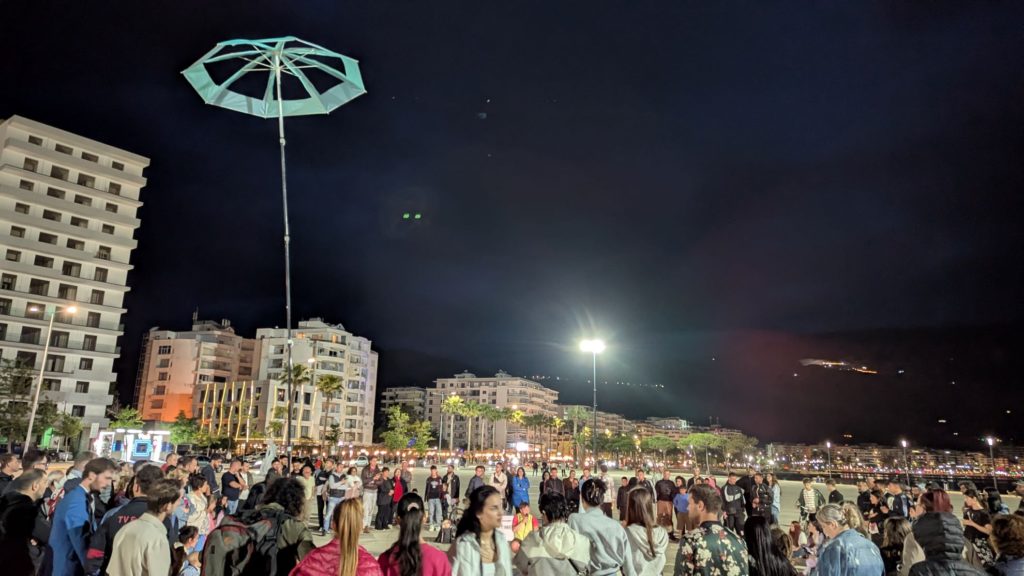
I like the effect in photos when something is above the crowd—either a performer or props like an umbrella, in your case.
How does it sound? I would definitely book my act!
Stefan Florescu’s signature trick with an umbrella. Photo Joanna Dryjanska-Pluta
Beginning of Stefan – the Umbrella Guy
When do you feel happy that you are inspiring new performers, and when do you feel like you have been ripped off? I know there was a time you felt this way.
After the second year of the pandemic had passed, I came out with a better 20-minute show. It was with football and diabolo tricks, but I felt I was missing a final part.
The following summer I met a Colombian performer on Constanta Beach, Romania. He was mostly doing traffic light shows. That means you only have about 30-40 seconds to do something very impressive (1-2 tricks), then you have to collect money from the cars and exit the road before the traffic light turns green.
He had this very impressive trick, famous in Colombia, of spinning a basketball on top of an umbrella while juggling with his hands.
He was good, but he didn’t know how to do a proper show because he had worked only at traffic lights.
I helped him and by the end of the summer season, he already had a decent show. He was so happy that he wanted to give me something, so he gifted me his umbrella and told me I could use it.
I started to spin the ball on the umbrella and simply balance it. It was already an impressive trick. However, we were going to perform the following year in front of the same crowds and he was doing it better, so I didn’t feel comfortable doing the same trick. For him, it was just one of the tricks in his show, so I couldn’t tell to the audience that it was my final trick and it’s very difficult if he is doing the same thing while dancing to samba music like if it were easy.
I had to improve it and do it in a different way than anyone else. I tried many things. From spinning more balls to playing diabolo and balancing an umbrella simultaneously. Nothing was good enough. Every night when we were performing, and every day when I was in a coffee shop. The only thing in my mind was how to make this trick my own.
One day, I was in Decathlon searching for things that might help in the show, and my wife saw a portable basketball hoop. She suggested I might be able to use that. In that moment, I saw it. That was the finale that I had always been looking for.
I learned the trick pretty quickly. A few days later, I was already using it in my show.
It was not only about having a strong finale. I finally didn’t feel like I was missing something, and I was happy with my show.
Over the next few years, more people found out about me, and more performers started following me. They no longer talked about the “football guy” Stefan, but about the “umbrella guy”.
I knew I had a trick that was valuable because it was spectacular, with a good ending.
Performers want to have a high finale to attract more audience.
Everyone does this by having a platform, a pole, or something that makes you high up. That made you carry a lot of equipment. I found a solution. My umbrella was high but collapsible, and because I made it out of carbon fibre, it is about the same weight as a bottle of Coke. So I expected that sooner or later, other performers would copy the idea.
When I first saw someone else doing it, I thought it was just funny. At the same time, I felt proud. It was the first time I saw someone doing something I had created. Soon, more people started to do it. I think by now, more than 10 performers have done or tried to do my trick in their show.
To answer your question, now I feel happy to see that I am inspiring other performers. At the same time, I think everyone should do as I did: find their own way to do it without just “stealing” the trick.
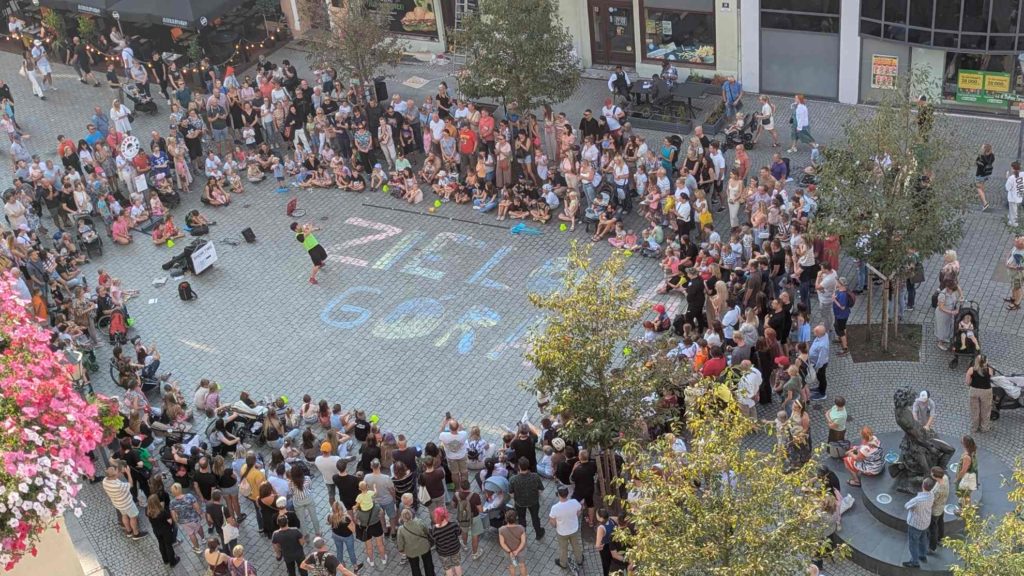
Street artist Stefan Florescu at Busker Tour in Zielona Góra photo by Małgosia Węglarz
Competitiveness drives performers to excel
Although you have been busking for years, you are quite new to the festival scene. What’s the reason behind it?
The reason I didn’t perform at festivals for such a long time was that, until the pandemic, my show was very short, so I didn’t even consider it.
Then, once my show was about 20–25 minutes, I wanted to do it, but everyone was telling me that I had to have a 45-minute show to be able to go to festivals. This alone made me hesitate for another two years.
I found out later that it wasn’t true.
Most festivals prefer a show of around 30 minutes. Others are flexible, and even for those who want 45 minutes, that generally includes setting up and dismantling.
I think that many festival performers don’t want others to join the festivals because they see them as competition for the slots. It is a wrong mentality that keeps their “level” low instead of growing.
I know art is not a competition, and there are many things you cannot compare, but I like to think competitiveness is good.
If you see that others are getting more festivals than you, try to improve, change details, and practice more. That’s how you grow. Not by trying to make it harder for others.
And read the open calls thoroughly and answer all questions in the application form, but we will talk about that later.
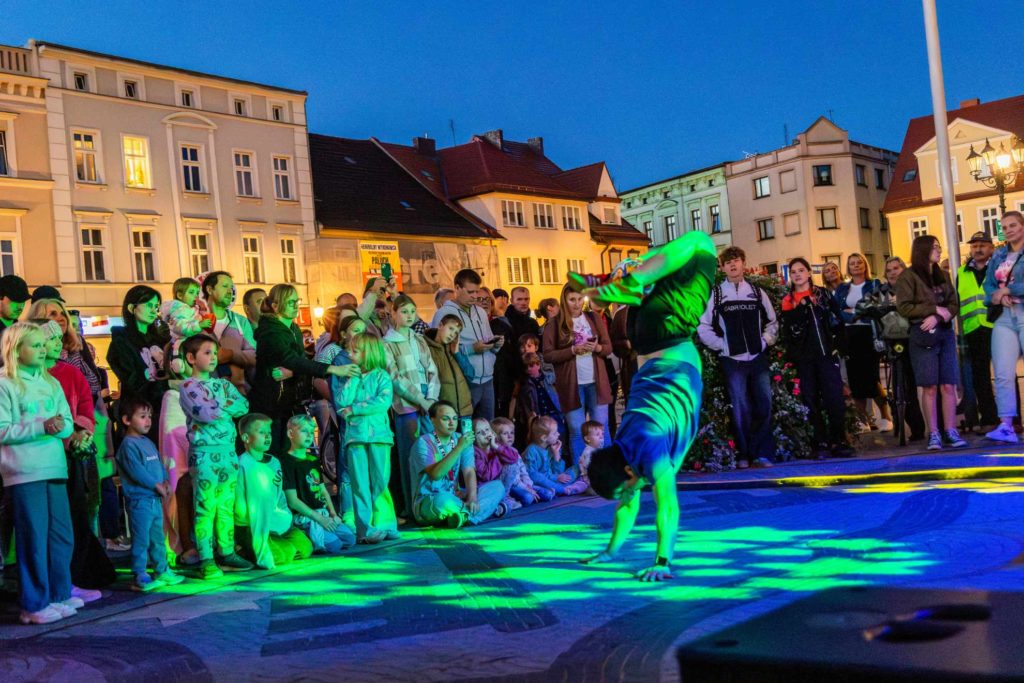
Stefan during the group show at Busker Tour 2025, photo Joanna Dryjańska-Pluta
A bad ‘hat line’ is worse than the silence.
What tips from fellow performers have you found to be misleading?
Other than that the show has to be 45-minute, I think another misleading tip I have received many times before is that you must speak a lot about money. You must have a money line, explain to people that you do this for money, how much they should give and put pressure on them to pay.
In Romania, we never used to have street performers before, and when I first saw performers doing this, I felt uncomfortable. I saw many times people not willing to come near to a show and whispering that a performer will ask them money later.
I understand that buskers live off donations, but at the same time, the beauty of street performing is that it is for everyone. And some performers are giving a bad image to the community by being pushy.
I think in 2026, there are not many people who don’t know that a street performer is doing a show for donations. I think a good money line can help. A bad one will only make it worse than not saying anything. I have seen amazing performers get everyone paying without saying a word.
The goal should be to make the audience pay and leave with a smile, being happy that they paid, rather than regretting doing so out of pressure.
I’m glad you mentioned that. The way a busker asks for money also shows an understanding of local culture (just like in some countries you negotiate the price everywhere, while in some it is disrespectful).
I ask performers at my festival to take down signs like ‘We are street performers; you need to pay us.’ In Poland, such signs are associated with begging.
Another thing that has the opposite effect, from my observation of crowd reactions, is a pre-recorded audio message.
After the festival in 2024, when many people used audio messages translated (usually poorly) into Polish, I got an email from a member of the audience saying they sounded aggresive. I agree with him. I was at shows when people left after hearing messages that sounded like they shouldn’t stay if they couldn’t afford to pay. This person wrote something that describes the Polish mentality best: ‘People would give performers more money if they didn’t feel forced to do it.’
I write on the flyers that, according to street theatre tradition, the audience can show appreciation by throwing money into the hats. It is the same goal, but a different tone. You give the audience a choice. Isn’t that what busking should be about? Isn’t making art accessible also to people who cannot afford to pay for tickets what half of the buskers write about on their websites?
Maybe ‘Don’t worry, if you don’t have the money, I appreciate you being here’ is the best hat line? As you said, hat lines can be polite. And show class!
I give the buskers I work with a list of various phrases in Polish suitable for street shows. I’m sure the audience enjoys a few words in their language rather than a long pre-recorded audio.
Buskers also need to remember that jokes don’t always translate. What sounds fine in their native language can sound rude when it is literally translated into another language. The same goes for the value of money. For example, 200 PLN is a lot of money in Poland, and buskers stating that they believe this should be a tip can make people feel uncomfortable.
Yes, I agree with you on this. I don’t really like it when performers put too much pressure on the audience about how much they should pay. Maybe it works for some, but it’s not the only way. And I don’t think it’s the best way either.
For me, the best way to get people to pay more is to make them feel good during the show. If they really enjoy it and they’re honest people, they’ll pay. And they’ll do it with pleasure.
Of course, there will always be some people who don’t want to pay for whatever reason. If you focus too much on them, you might just annoy the people who were already ready to support you, and even make them change their minds.
I think the mindset matters a lot. If you start your show already thinking, ‘These people won’t pay.’ that energy is going to be felt.
Instead of focusing on how the audience will make you happy with money, think about how you can make them happy with your show. It is only natural that when people feel good, they give street perfomers money.
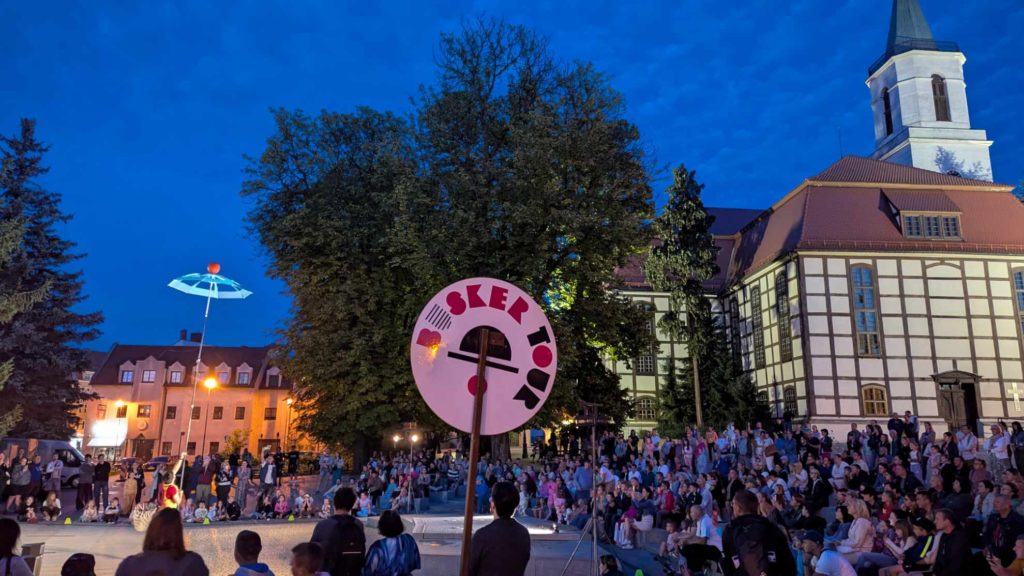
Busker Tour in Zielona Góra
That’s nice advice for buskers! What is the best tip you have ever received?
I think the best tip that I have ever received is not related to performing, but to how we perceive life.
Don’t waste your time when you are young only saving money for when you are old and won’t have the energy to do what you now wish.
I think this is now a very important part of my vision of how I plan my life. Of course, we should consider being financially stable when we are old so we have easy retirement years. However, when we are old we are not going to be always healthy. We are not going to have the same energy as now. So we should do the things we like now.
Street show at Busker Tour festival. Photo Joanna Dryjańska-Pluta
You recently shared a post on Instagram with a graphic saying, ‘Hey festivals, you have to pay me,’ which, no surprise, has gone viral. We have spoken about it, so I know you didn’t mean to start a “let’s kill the busking festivals” campaign. Let’s clarify that to everyone!
When I started performing, many event organisers in my hometown were telling me to perform for free because they offered me exposure. Then, when I started to perform outside of my town, the offer didn’t change.
Everyone was always trying to frame it as if they were helping me by having me work for free for them. I never accepted this.
Now, as I have started to apply to festivals, I get many offers like this again. Some are even asking me to pay for transportation and a hotel, while I cannot collect donations. They say it would be a nice chance for me to get noticed. At the same time, they sell tickets, merchandise, and sponsorships. I have never accepted something like that.
I know that there are always performers at the beginning of their road with hopes they can get tricked by these kinds of offers. The truth is that if you don’t put value on yourself, no one else will.
I posted this graphic, because I wanted, now that it is a new season of applications, to remind new performers of this.
I was never against busking festivals. In fact, I go to many of them. At Busker Tour and other busking festivals, you get accommodation, food, transportation reimbursement, or sometimes a fee. The idea of busking festivals is that you get paid by the audience directly. The audience knows that when they come, they are more likely to pay than at a normal street show. In the end, you get paid for your work.
At some festivals, you can earn more, at others less. At some of them, you get more exposure, you make friends, and you learn things. At the same time, you don’t do it for free.
Street performance by Stefan Florescu at Busker Tour. Photo Joanna Dryjańska-Pluta
Open calls, emails and lists – the festival application process from different perspectives.
What have your experiences with festivals been so far? What have they given you, and what do you dislike about them?
I love to perform at festivals. After performing only on the street for a long time, it feels like a street show on “Easy Mode.” I feel more appreciated. I know that artists who have never done street shows outside festivals would not agree with me.
I don’t think I dislike festivals. It’s more that dislike the process of getting accepted into them.
I think that it’s sometimes like a closed loop that makes it hard for outsiders to join. I think the application system has issues, some people try to keep festivals under the radar, while other festivals accept only people they have seen live, or rely on recommendations more than applications.
They would rather have something decent that is sure to work, rather than risking new performers who might be amazing but might also be bad.
I understand the festivals’ point of view. If the circuit were year-round, it would work. You get noticed at some point and start to be in more and more festivals.
The issue is that it’s only a few months a year, and once you don’t have any confirmed festivals after the application season is over, you must wait another year for a new chance. Some performers wait for many years before they start to have a career.
That’s here in Europe, but in Canada, it’s even harder. Most festivals just repeat the same performers every two to three years, and it’s almost impossible for outsiders to get in.
I know some things are hard to solve.
We must do more things for new performers. The way you publish tips for performers on your website busker.pl (how to make a promo, an application, etc) is an example. We need more things like that.
We need tutorials, something like the one “the fire ninja” shared on YouTube on how to be a festival performer.
There should be public lists of all festivals so that even new performers can apply. There should be easy to find and free. I know that some performers who already have many festivals would prefer it not to be like this. This is, again, a wrong mindset.
Thank you. I’m glad someone checks my articles! I think our conversation is filled with tips too!
I disagree with the list. It crossed my mind in the past to post one but I realised that it is not good for either performers or festivals. I see it in my inbox. Many performers find my email online, copy it from the lists on forums or get it from someone, but they do not check what I have written on my website. They apply or send me multiple emails, even though they have no idea what they are applying for, and despite me stating on my website that I consider only applications submitted via online form when I announce the open call for buskers.
I put a lot of heart into working on line-ups. I give buskers the chance to debut at the festival, and I prefer to have a few applications from people who are grateful and will enjoy the experience rather than receiving mass emails starting with ‘Dear organiser,’ followed by ‘I would be a perfect match for your festival,’ even when they do not know which festival it is. I know that not everyone will be happy at Busker Tour. Some may have expectations I am not able to meet.
Every year, I have to deal with cancellations by performers who confirmed their participation but were treating it as a backup plan in case they don’t find anything else. This is not fair, and speaking of public lists, this should be the one!
You mentioned another topic here.
Being a curator is a job, but numerous (most) companies, municipalities or NGOs that want to organise festivals don’t think about it.Many people responsible for line-ups are not real curators when their “artist selection” is more like copying other festival lineups.
If they don’t want to risk inviting buskers who are unknown in the festival world, those buskers will be rejected anyway.
Both festivals and buskers should put in the work in their tasks.
Organisers should promote their festivals so they reach the performers, and they should be honest about who they are looking for. If they want to invite only performers who have been to other festivals, they can say so.
If they want to invite only performers with previous festival experience or select only performers they know, they have the right to do so. Maybe they copy their own previous line-ups or those of other festivals. However, if they still announce an open call, what is the real reason for asking performers to apply?
Buskers can also do some research to choose the festivals that resonate with their attitude and expectations.
Performers often send hundreds of random emails that are treated as spam if festivals accept applications within a specific timeframe and way. Then, they complain that they haven’t received an answer. They would save time not by copying emails but by learning a bit about the festival and sharing their offer when someone is interested in reading it. If festivals share their conditions, why do buskers who are not happy with them still apply?
I meant that it is so hard to find all these festivals. I understand that performers should research festivals before applying, instead of just copying and pasting emails and not even knowing where they are sending offers.
I understand, but, Stefan, we both know that most of them won’t. Do you think that my “Please note that we do not respond to or consider offers sent via email or social media. Every year around February-March, we announce an Open Call and check only applications submitted via our online form.” stop everyone from sending DM’s and emails?
There is no one solution that would work, no matter how many ideas we will throw around. Different things work for different festivals and performers, but that’s why I mentioned this honesty and transparency.
Not every festival is a gig that performers do for the highest fees, not every street festival wants buskers or has a mission to promote street artists or discover new talents.
If you haven’t heard about specific festivals, they are not doing their job of building the brand and reputation.
When I see festivals that copy my descriptions and use them at theirs for their events – they have no idea what and why they organise. They wouldn’t have any clue about most of the things we are discussing now.
There is one more thing that we should mention. If a festival organiser calls it a festival for buskers but there are literally zero buskers in the lineup or when performers who are not buskers claim that they are in their applications just to get in, then for me, both sides are not being honest.
I know you are looking carefully at who you invite to Busker Tour. I honestly believe that many other festivals don’t read the applications and just have a quick look at the video at best.
Some of them just take performers who were on Busker Tour before. I saw that pattern with performers like Chien Hung, Gaku, Cesco and even me this year.
But what do you think is the solution if you are a performer and apply to a festival that receives 1000 applications? Obviously, from a 1-minute video, they cannot know if you are good or not. So many performers look amazing in their promo and they fail to deliver once at the festivals.
First of all, thank you for noticing my work and sharing your feedback. So far, Chien Hung has been one of the few people who have thanked me for that.
The main reasons why I don’t select given applications is that people don’t answer the questions in the application form and don’t provide a video that is more than just a highly-edited short promo.
Sometimes people complain that the text in my open call is too long. It is long because I have answered all the questions anyone has ever asked me, or may have.
Actually, I truly appreciate all the tips you give and the fact that you provide clear information on what you are looking for in participating artists. I am actively trying to understand what organisers look for when they book artists. I think most of the time it’s not as clear as in your case.
I have no idea how others choose their acts because there is usually not much about it on their festival websites. I have conducted as much research as buskers do to understand how other festivals work.
Maybe the lack of this information, as well as the fact that performers often don’t read it even if it is available, is the key?
Maybe bookers don’t invite people they haven’t seen live. Maybe they go to many festivals and decide then? Or, in a less pleasant scenario, they copy the line-ups of other festivals. In all these cases, you would be wasting your time sending them an application if they don’t say it on their website.
Your list would cause more festivals to receive hundreds of applications, so it would not help “unknown” performers to get booked. Please, do not add my email if you create it!
I remember I received an offer from one website to be added to this kind of list. It was free for me, but the performers were supposed to pay. It made me sad that someone would pay to get my email address (only to send me offers via email that I wouldn’t consider). So the only party that would benefit from it would be this website, charging performers for access to email addresses and making empty promises that it is an investment to get more bookings.
By the way, this bragging about the number of applications sometimes looks like it is was the way to measure festival quality or a game of who can throw a bigger number.
Linz invites a lot of acts, and it is famous, so most of the performers apply. A festival that invites only ten acts doesn’t need five hundred applications. How do they all choose the line-up? Is it a lottery?
I don’t know if they really receive that number of applications or if they believe they will look more successful if 1,000 artists apply to them. Linz, Zeitenwanderer and a few other festivals, for example, I see they send many reminders. So it looks like they want a lot of applications.
These numbers might be realistic, though in the case of many festivals, it is difficult to believe it when you look at how similar their lineups are. It is impossible that among these 500, 600, or whatever the number is popular this year, there are zero new performers who didn’t have good applications.
I think I have about 700 email addresses saved in a mailing app, and I save only contact details from performers who applied via the application form and have opted in. It doesn’t include email addresses from people who send me offers via email (and more do that than actually apply). I don’t know how many of them are still performing.
Busker Tour is not a festival where everyone applies. The ones known for good hat money, probably have way larger lists if they update them.
When the festivals send out newsletters, I assume most people fill out the form, even just to check if they can be invited. Like it was a game.
Sometimes when performers say “oh, they rejected me again” or when they try to ‘force’ festivals to invite them, I think they don’t realise they are not the only ones doing so.
Mass newsletters (meaning to every single contact) don’t work for me. They only result in having many more people to say “no” to. And I mean more people to say ”no” to who I’m sure have shows I would like to see. But also the ones I didn’t include in the line-up earlier because I didn’t enjoy their applications, or, for example, I had unpleasant experiences with them or they made it clear they didn’t enjoy working with me. Why would I encourage everyone from the second group to apply again if I already know I won’t invite them?
When I promote the open call, for example, on social media, most of the people I reach follow me, so there is a chance, at least a tiny one, that they have some idea on my festivals.
In my case, what works is fewer applications but from people who make me believe that we are a match. Like in any other jobs—because what I do, post on my website and how I work resonates with them and because who they are and what they do is something I admire. In the end, it doesn’t always work, but often that happens because their expectations turn out to be unrealistic (for example, because they require a budget I don’t have). They probably would not have those expectations if they had read everything in the open call.
Also, I give an example of my open call, but I announce open calls only for some legs of Busker Tour. For the others, I mostly choose people I have seen, whose shows I liked, who I find reliable as performers, and who are kind as people, and whom I can vouch for (also financially!) as that’s what people who hire me expect. I can’t risk cancellations there; I need to trust them. It’s also an opportunity for me to reunite with artists I’d like to work with again. If it is a paid gig, I don’t want to work with performers who advertise themselves as “professional” but then tell me, ‘I’m a street artist, I don’t care about invoices, and other formal things’.
It’s funny you opened this topic.
How many invoices do you think are made with ChatGPT?
When I first started going to festivals I encountered this “problem”. I didn’t have a company because I was doing more street shows. In Romania it’s very difficult to register as a performer. I asked other performers how they solve this problem, and how they provide invoices. Every time, I felt they were trying to avoid speaking about it. Like it was a sensitive subject. Without any guidance,
I finally succeeded in registering my company. It was not easy. There was a lot of bureaucracy and things that I don’t like to do, but I understood that I must do it all if I want to grow as an artist and be part of festivals. After all the effort, guess what? I saw that many of the artists joining festivals, are not giving proper invoices. I heard multiple times things like: ‘They don’t care. They just need proof that they paid us’ and ‘They don’t check in your country’.
I saw that some performers think invoices are just like files you can create with ChatGPT that has the only purpose of keeping track of payments and expenses. Like a handwritten letter acknowledging that you got paid by the festival.
Every time I issue an invoice I need to pay taxes in Romania, and I need to declare it to the National Tax Agency. Everything would be much easier if I just asked ChatGPT to create one. However, I believe it’s not only the wrong way to do it, but I feel like it’s even illegal and can create problems for both the artist and the festival.
Can you tell me your opinion as an organiser on this topic?
You are talking about illegal things, so there is nothing I need to add.
Organising a festival is very stressful and it includes worrying about whether all the papers are correct, signed everywhere, and so on. Having to constantly explain to performers that everything requires a lot of formality is one of the reasons why many festivals stick to travel reimbursement only, without offering fees.
In some countriesm things are easier, in others they are complicated. Whoever wants to work internationally needs to understand that, collaborate with the other side, and provide all necessary, and, of course, valid documents on time. If someone tells you: “I need this and that,” it’s not because they are having fun or trying to make your life difficult. Whether it is a fee or travel reimbursement—we need a legal basis to give you the money that is recognised in our respective countries.
I often hear from performers that they are ‘professional performers’, unlike ‘normal buskers’. I don’t understand what ‘professional’ is supposed to mean here, but for me, it would be your path—understanding that it requires a formal approach. Again, like in any other job. If someone wants to be ‘a free spirit’ then why do they apply for festivals that, by definition, are an organised thing with a structure and rules?
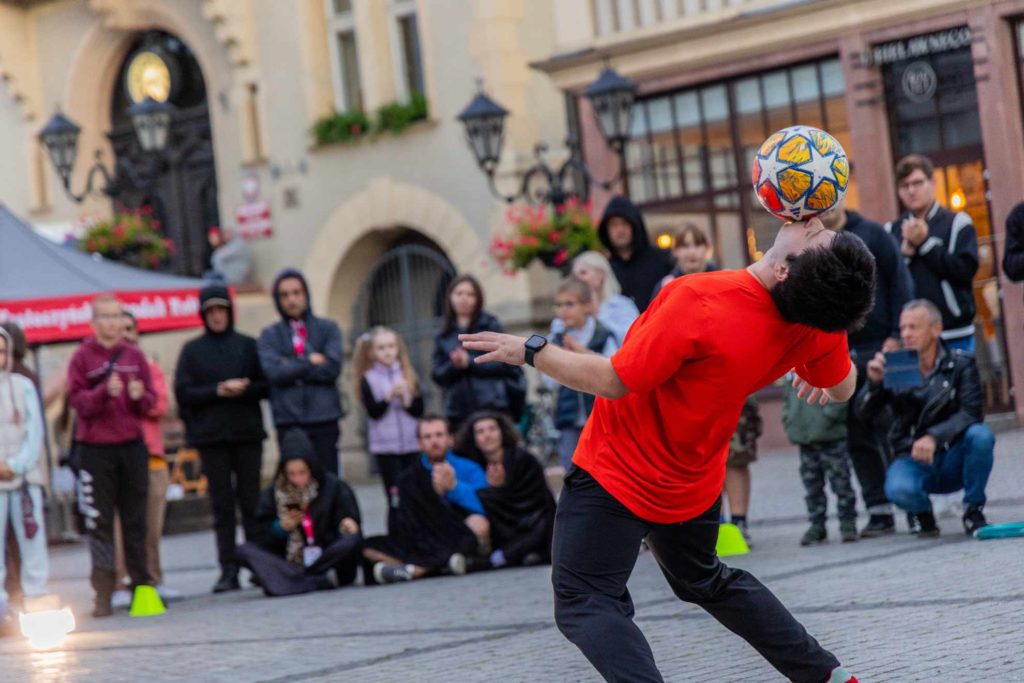
Freestyle football trick by Stefan. Photo by Joanna Dryjańska-Pluta
We see other people’s success, not their process
We mentioned Wu Haw Jong earlier. When I announced him in the Busker Tour line-up, you sent me a message, “He is a humble guy, and you won’t be disappointed”. To be honest, I can name only a few people who ever sent this kind of message (and probably all of them have been interviewed on this blog). Most of the time it’s ‘why did you book this performer, not me?’ or ‘How do I apply?’.
I think this kind of message ,‘Why him and not me?’ comes from a limited mindset.
It’s easier to question someone’s success than to question our own growth. Because it feels safer to pull other people down rather than to look in the mirror
When we see other performers succeed, we automatically compare ourselves. In our heads, we know our sacrifices, our hard work and our intentions. But we don’t know theirs. We see only their success but not their process, so it’s easier to believe that we deserve it more.
I also sometimes look at other festivals and think that I deserve to be there. However, I try to also remember that every artist has their own journey that I don’t fully know.
Every organiser has reasons that I don’t fully understand for choosing another artist over me. If someone gets booked, instead of asking ‘Why not me?’, I think it’s better to ask ‘What can I do to improve?’
If we celebrate each other, we grow stronger. I would rather celebrate someone that is good than try to weaken him. There is space for everyone to grow. The world is huge, and there are enough opportunities for all of us to perform and to get noticed. But it takes time.
I hope that is one of the answers people will remember from our conversation!
Not many people think about how these comments affect the other side. When I post reels, I am promoting the festivals I run and the performers, but not every post is an invitation to send offers. Sometimes I think how nice it would be for people to share nice festival memories in the comments or admire a busker’s skills. When the only reaction is “oh, time to send her an offer” it kills my joy. I am happy that there are performers who want to come to festivals I curate, but I don’t want to make my life about reading offers every single day.
It’s as if, for many of my followers on social media, everything is about selling their shows, without showing any support for others.
I think some people will see the name Busker.pl, and they don’t think that they are speaking with a real person. They see it as a festival page, and everything they say must be related to the application. I see you constantly posting on Instagram that it’s not the time to apply. “Please don’t send me offers!” Does that work?
Nope! And there is my name in the bio. Or even two names as I have a low tolerance for people butchering my Polish name! Maybe I should add it to the username, but I don’t think it would change anything. After all, people do send me offers via my personal channels. I sometimes reply that I am a human being too, not only an ‘agency’, ‘organiser’, or ‘festival’.
How do you differentiate a friend from a business connection?
Everyone is your ‘friend’ when you announce an open call for artists. The truth is that it is hard to know. A real friend is formed after you have shared some experiences together.
One filter that shows me who is a friend to me is when a person makes fun of me. People who are business connections don’t feel confident to do it.
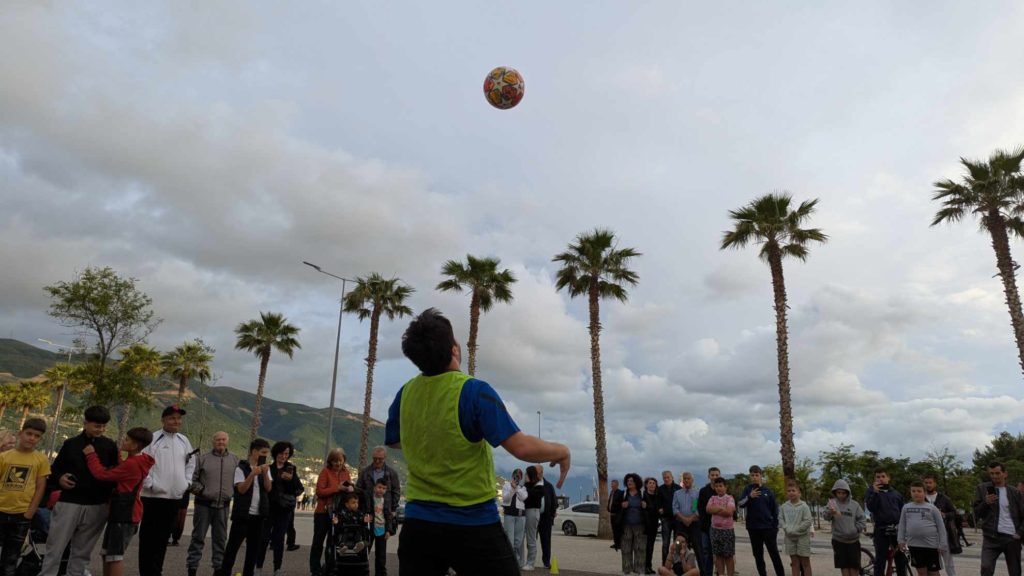
Street performer Stefan Florescu at Busking Balkans in Vlora Albania, photo Małgosia
What getting married has to do with a viral video
Your video was the second most viewed Facebook video in 2016. Has going viral changed anything in your life?
Over the years, I have gone viral in one way or another a few times.
First, when I was in Romania’s Got Talent finals. It was the first season ever in Romania, and I was at that time like a K-pop star in my country. It reached the point where I couldn’t go out and have a normal life because everyone wanted a picture. Gradually, that slowed down and over the years, people forgot about me. However, I wasn’t the same kid anymore.
The story of my viral video is crazy. When I was doing street shows on the Romanian seaside, one woman came up to me and said: “Tomorrow I will come to film you and post on my Facebook so everyone will see you.’ I said: ‘Wow, thank you!’ but in my mind I was thinking: ‘Yeah… bla bla… whatever.’ To be honest, nobody would have thought anything of it.
But the woman came and filmed my show. A vertical video, low quality, which she posted on her Facebook account with 84 friends.
But, as if she somehow could predict the future, that video got around 100,000 views from her regular account. Then, one group reposted that video and got 1 million views. Then, another page reposted that video and got 10 million. Something was so strange about that video. People were triggered by certain things, liked other things that made them watch it many times and comment. Somehow, that video had the recipe to go viral.
Because after that, another page with only 500 likes posted it and got more than 250 million views. And then another one got 160 million. I gave up counting at some point. There were more than 500 million views in total and tens of thousands of messages (almost 10 years later, I still haven’t finished reading many of them).
I got some money out of it, some opportunities to perform. Not many, though, because I wasn’t ready. My show was not big enough to deserve bringing me around the world at that time.
But the best thing that happened to me after my video went viral is that one of the people who messaged me was Aisa, who is now my wife.
Have you ever seen or spoken to the woman who filmed you since then? It sounds like she has changed your life!
I stayed in contact for a while. She had a kid the same age as me and she spoke to me almost as I were her second child. After the video went viral, I was contacted by LAD Bible. who wanted to pay for my copyrights to sell the video to multiple clients. At that time, I realise that i didn’t own the copyright. I found out that the law is very unintuitive.
Fun fact: Did you know that the person who owns the copyright is the person who holds the camera?
For example, if you give me your phone to record you and I do it, legally I own the copyright, even if it is your phone, it’s you in the video, and it was your idea.
Back to the story: LADBible asked me to contact the woman, and sign a contract where she voluntarily transferred the copyright so I could get paid for the video.
I was very shy about it, but she didn’t hesitate. She did it, because she truly wanted me to become known. She didn’t want to earn anything from it. I remember a few years later she came to the seaside and greeted me again. Unfortunately, I lost contact over time, but i will never forget what a stranger did for me that changed my life.
Yes, I know that being in a video or photo doesn’t mean that you own the copyright and can do what you like with it. No one could sell a video of you though, for example, to be used to advertise a product as they would need permission from you to use your image. That’s why a festival needs a clause in their contract with artists stating that they can use photos taken of them during the festival to promote future editions, and so on.
This is also a good place to remind performers of what I pointed out in my article about photos: no, you cannot just save a photo someone took of you and use it as your promo photo, simply because you are in it. It is not your photo. Hire a photographer or videographer and get a formal licence or full copyrights before you send something as your promo materials to festivals. Organisers cannot use stolen photos and unknowingly infringe on copyright because of you.
Busker Tour 2025 in Krotoszyn, photo by Małgosia
What is your approach to social media now?
I have always been too lazy to manage my social media. I think it is like performing. If you want to be big in social media, you need to invest a lot of time. You need to follow trends and always post. I don’t have the patience to do that. As you can see, I had a page with 200,000 likes on Facebook that got hacked. When I saw how complicated it was to get it back I didn’t even bother. I just quit Facebook.
Now I only have Instagram, but I post mostly stories that I like. I arranged my profile to look nice in case some organisers check it, but other than that I don’t actively try to improve my online appearance.
Stefan Florescu performing at Busker Tour in Krotoszyn, photo by Małgosia Węglarz
Taiwan is what people imagine Japan to be
Most of the performers go on tour for a few weeks or months. You are constantly on the move. What does your life as a nomad look like?
I don’t try to ‘do a tour’. I generally try to go to Asia every winter. I don’t like the second part of winter. The one when the snow is melting and becoming muddy. I think I have been to about 45 countries. That does not say much because within the European Union, everyone can go to twenty countries in two months. I didn’t have a starting point when I said ‘OK, now I will start to travel around the world.’. It just happens that I have never had a stable place to stay for more than a month
I don’t pack lightly even if I travel somewhere for the weekend. How do you pack for a few months?
For me, it’s easy to pack. I don’t get attached to objects. The truth is that if I remove my show equipment from my luggage, I am left only with shirts and pants. I also have a cat figurine (because I cannot travel with a real one), a watch from my brother and a mini-chess board
You travel with your beautiful wife, Aisa. Greetings to her!
She is the opposite. She has a suitcase, as big as mine, full of clothes. She is passionate about clothes design, and she studied this. She has to have clothes that match one another in ways that I cannot understand.
I have noticed! We even spoke about it in Zielona Góra that she always looks classy. Does Aisa choose your next destinations as well?
Most of the time I am the one who does the planning. One of the countries we visited because she really wished to see it was Japan. It was her dream, so of course we did it.
Do you have any daily routines that you like to keep no matter where you are?
Yes. I try to walk more than 10,000 steps every day. I’ve been doing this for a few years now.
You have tried the food from different parts of the world. What is your favourite one?
I think my favourite cuisines are Taiwanese and Thai food. My favourite dish is butter chicken (Indian).
What are your favourite cultures and places that you could recommend to me to visit and experience?
I would definitely recommend that you visit Taiwan. In my opinion, Taiwan is what people imagine Japan to be. It is an amazing place with amazing food. It is a very convenient place that culture-shocked me the first time I was there.
Taiwan is definitely at the top of my list and I am dreaming of working there one day. I even have Busker Tour description translated to Taiwanese and Japanese!
Maybe one day, you will do Busker Tour in an Asian country. Or, I think it would be very interesting to have the international Busker Tour in two or three countries. Since it is a tour, it would be super fun.
That’s my dream and goal! I have learnt over the years that I need to speak of my dreams aloud, otherwise how can people know about them? So, this one is for people who can help make this happen: hire me!
If you were about to settle now, where in the world would it be?
For a long time I thought that if I were able to get a permit to perform there, I would choose to settle in Taiwan. I think it’s one of the best places to live. It is the safest country I have ever been to. You can eat out in the city for less money than you would spend on cooking at home in Europe. All the food is delicious, the people are incredibly polite, and it feels like there is less bureaucracy than in Europe. It has very good public transportation and beautiful cities. It was like a dreamland for me. After all these years, it’s still one of my favourites.
It sounds exactly how Kuo Chien Hung has described it to me and how it looks in all the postcards he sends to me!
The ‘Show for Everyone’ project
Tell me more about your charity project.
I used to perform in the winter in Taiwan and Hong Kong. However, once the winter holidays are over, it’s not the best season to perform. I had to force myself to perform and I was not enjoying it, and people didn’t want to see a show.
I started thinking, “Why am I doing this”? I thought maybe it would be better if I just went on a vacation in the Philippines, to relax, take the time to apply for festivals and focus on the next season instead. Once I was there, another thought came to my mind “What if I did some shows for the kids? It would cost me almost nothing, and I also need to perform so as not to get out of shape.” So, I did it.
And trust me, once you do it once, you can never stop. Performing for the kids who have never seen a show in their lives is something special. Something that I had never felt before.
So I started a new project which I named “Show for Everyone”. I decided that every year for a few months I would go and perform in isolated places for kids who have never seen this kind of show before. To make them happy, but mostly to inspire them. The way I was inspired by the first performers I saw on YouTube. I want to transmit to kids around the world that they can do what they like if they don’t give up on their dreams.
Now I am already in the 3rd season of the project and it is getting better and better.
I think that at the same time I am being booked for more festivals because of my project, but I don’t do it to get more festivals. Now I am at a point where I don’t care. I apply but I know that with or without festivals I will have a good future as a performer and my goal is to grow my “Show for Everyone” project until I am able to also bring other performers with me to perform in isolated communities.
From the middle of the desert to the jungle. The world is big and many people need to learn about street artists.
How can people support your activities?
People already support my activities by donating to my show. The best way to support my project is by following it, and telling others about it, so it reaches more people.
You will not always earn more in richer countries
What has been your favourite country to perform in so far? Does the audience react differently depending on the country?
The audience definitely reacts differently. In Taiwan, they are very quiet but very respectful. There are no hecklers and people have the patience to wait for you for a long time until you start so you can have a long build-up before you start the show.
In Romania, if you do that for example they will comment. They will tell you: “Come one. Start already.”
In Taiwan, if you do a pose, people clap. In Romania, I had to teach them that they must clap when you pose. I think we don’t have this performing culture. At the same time, the energy in Romania is great. I think my favourite show so far was in Sibiu, at the FITS festival.
But more than to say that some countries react more than others, I would say that people who have never seen shows before are very nice audiences to perform for.
Best crowd and reaction you have ever seen during busking?
I believe by busking you mean a regular street show, not at a festival. I would say the best reaction I have ever had was in Puerto Princesa, Philippines. I think they had never seen street shows before and Filipino people are also generally very happy and excited audiences. When i performed there I couldn’t hear my speaker anymore. That’s actually hard for me because I try to do tricks to the beat of the music. But… I cannot complain!
What have you learnt over the years about performing in the street?
One thing I have learnt over the years is that you will not always earn more in richer countries. I am not talking about festivals but just regular street shows. All performers go to London, Berlin and other famous places for performing, but they would be surprised how good street shows can be in Chisinau (Moldovia) Iasi (Romania), Belgrade (Serbia) and many other places that are not well-known for busking.
Freestyle football trick by Stefan Florescu at Busker Tour. Photo Joanna Dryjańska-Pluta
What has been the most terrifying moment in a street performance to date?
I think I have never been involved in a terrifying situation involving street shows. However, I went to do street shows in Istanbul in 2016, immediately after the army tried to take control of Turkey and to take down President Erdogan.
The situation was tense, and there were armoured vehicles patrolling the streets. I was in the middle of a show when a tank came towards me (yeah, a real one like we see on TV or at an annual army parade). At the time I didn’t know how to react. I was in the middle of the routine. I thought I would just move back while doing tricks, the people would move aside and the tank would pass. Little did I know that the Turks are very resilient people. They also hated the army after what had recently happened. To my surprise, none of them moved. The tank came closer and closer. Nobody moved an inch. They didn’t even pay attention.
So there I was, doing football tricks with the tank’s cannon hanging above my whole stage and crowd. And they waited until I had finished and collected at the end. Then he passed. A few minutes later, two well-dressed men came and told me that I must go.
I have heard stories from buskers in Turkey who said that there were times they were beaten up as well. By the way, walking on Istiklal Street whilst it was filled with street music was one of the most beautiful experiences of my life.
So, basically, the rule in Istanbul was that you could perform but you couldn’t have a crowd.
Once musicians had more than 10 people, they would stop for a few minutes to let everyone go away. They were very paranoid about terrorist attacks on crowds. That is such a weird approach because crowds form even on a traffic light until it becomes green. I think it’s a useless solution that doesn’t fix the problem. At the same time they are called ‘terrorist attacks’ because their purpose was to create fear. So, by stopping street shows, you just prove that you have lost the ‘war’ against terrorism.
The street is just another place to perform
Do you think that busking should be regulated? If you had to decide, what would be the best busking rules?
For me, the street is just another place to perform. I don’t do it to escape the system or avoid taxes or whatever the dream of buskers was many years ago. I want it to be regulated, I want to respect the laws, to pay taxes, and to have the benefits like any other normal job.
I don’t think there are general rules that work everywhere. I think local councils should speak with performers before they create regulations. Many times they just copy the rulebook from other countries and you get rules that don’t make any sense.
For example, in Romania we have a rule against using speakers after 10 pm at a beach resort where everyone goes to party. At 10 pm people are just going out. The area is full of clubs and it is very loud everywhere, but the police doesn’t want us to use speakers because ‘it’s late’. This is an example of rules that are copy-pasted thoughtlessly.
What tips do you have for beginners? What kind of advice could you give to young performers like you?
I would say: Listen to advice and do what you want. Consider what others say but don’t let people design your show. The most memorable performers, singers or any kind of artists are the ones who did something that they liked until people started to like it as well. Trends change all the time. Don’t chase a trend. Become one.
I always like to do a lot of tricks, but everyone keeps telling me that I must talk more and do fewer tricks. That people will get bored if I do too much. I want to prove them wrong. So every time someone tells me that I should do fewer tricks and speak more, I add one more trick!
Freestyle football in Krotoszyn. Photo by Joanna Dryjańska-Pluta
I like tricks, but I also know that although you don’t talk a lot, you do interact with the audience. How do you build the crowd?
I think building a crowd is an entire philosophy.
There are so many techniques, rules, tricks, and timings. They also work differently in different places. I cannot say how I build a crowd because it really depends on the situation, the place, whether it is a weekday or weekend, if it is a show in the sun, the shade or at night, with a fast flow, slow flow of people, among many other variables.
But one thing I like to do and I see not many performers doing is to have a proper schedule. Everyone thinks that street shows are just random. I like to go earlier and put up a clear sign with the show times. It’s not enough to just use a marker or chalk to write it on a board. It has to be printed, to look professional, not like something that can be moved.
15 minutes before the show, I turn on the music. You will often see people looking at their watches. Some of them will come back to see the show. Most of the time, I have people waiting for me to start 5 minutes before the show time. And that is a great start. It’s not only about having a few more people. It’s always better to start with people and build around them. Also, if people are waiting for you, don’t start earlier. Letting people wait creates anticipation and value. They are waiting for you. So, you are not a performer looking for a crowd. They are a crowd waiting for a show. And that changes a show a lot.
Stefan Florescu performing with diabolo. Photo Joanna Dryjańska-Pluta
As a spectator, what shows make you stop and stay on the street?
I think what makes me stop to watch is when I can feel the professionalism of the performer. I can feel if a show is good before it even starts just by the details that show that the person knows what they are doing.
Who are your favourite buskers and what are the best shows you have ever seen?
I have many performers that I like. Richard Circusstar (Taiwan/Ghana), Issac (a performer from Taiwan doing Cyr Wheel). You would probably not know many performers that I like, because they never leave Taiwan.
My favourite performer is maybe WillStreet. The legendary breakdancer from France.
Busker Tour is becoming Asian! Who knows, maybe I will meet them either in Poland or when I get this job in Asia!
What routines and jokes do you consider the most overused and boring?
All these jokes like: “Don’t do this at home, do it in school”, or “this is my manager” make me feel weird. One pattern that many performers are using, and it already shows me that it’s not a professional show, is when they tell you that they will start with one, two or three warm-up tricks and the audience has to make noise after each trick so that you can start the show. I think it’s such a bad structure and performers still use it. It only shows that their show is not long enough in their opinion, and they try to stretch it.
Maybe it’s their crowd-building method? I don’t like shows where performers talk all the time about the ‘grand finale’, but the final routine is the only thing they have. Maybe we mean the same thing?
It is not a crowd-building method. They do that after they have gathered a crowd. It’s a structure performers use to get energy from the crowd while they stretch out their show.
Building the show around one trick is the Australian style. And the whole show is actually a build-up. It works in places where the audience is hard to stop and easy to leave once they have seen what they wanted. Performers try to keep people entertained while not showing much until that one finale trick.
When people are already on your side and just want to see your show, you cannot just spend 30 minutes promising and do one trick because it’s disappointing.
Stefan performing at Busking Balkans: Vlora in Albania, photo by Malgosia
Stefan, we have covered quite a lot of topics! Is there anything I have missed or that you would like to add?
Yes. Today, after performing at a school in a small town, one of the teachers told me that his wife had passed away a few days earlier. He said that this was the first time since that moment that he had smiled, and for a few minutes, he was able to feel happiness again.
It was the most beautiful and, at the same time, the saddest compliment I have ever received. It brought me more satisfaction than money ever could.
Moments like these remind me that as performers, we have the power to influence people in ways we may not realise. Each of us can make a small difference. And when many of us choose to use our art with intention, small differences can become meaningful change.
It’s not the first time I’ve heard about a similar story. That’s the power of street art.
And to add one more positive message to all the buskers who want to perform at festivals: festivals do have a limited number of acts they can invite. ‘This year you are not invited’ doesn’t always mean that someone hasn’t checked your application or didn’t like your show.
Don’t get offended when someone doesn’t invite you. Instead, appreciate it when you get an answer, reflect on it, and choose which tips resonate with you and you want to implement.
Street art is not Botox. It’s not about making every show look the same. I always say that a performer’s charisma is one of the elements that make a show unique.
Take the time to find a festival with curators who give buskers a chance with their first-ever invitation to a street festival. And when you get the chance, use it wisely! And stay humble.
Thank you, Stefan! I’ve had a great time chatting with you! I wonder if anyone will have read the whole thing. Hopefully, they’ll let us know. See you at our next diabolo jam!
Author
Małgorzata Węglarz (Margarita)
I like colourful dresses, pink lipsticks, Greek olives, sunrises and sunsets, puzzles with Klimt's paintings, and buskers.
I share here my love of street performing arts, and tips and insights as a producer and artistic director of Busker Tour.
Along with managing events under the Busker Tour brand, I collaborate with international partners to curate and co-produce new and existing street festivals.
I finished reading the entire article, and it is truly an in-depth and insightful discussion! Thank you so much for mentioning me. I learned a great deal from the many topics you covered, whether it was the insights on festival applications or how to engage with audiences on the street.
By the way, I actually prepared my own application materials based on the ”Tips & Tricks“ shared on your website. Furthermore, whenever other Taiwanese performers ask me for advice on performing abroad, I always recommend your website to them.
I really want to thank you for providing such clear guidance for performers without prior festival experience. You‘ve truly helped us take that crucial first step.
Thank you so much!
Thank you, Wu Haw Jong. I appreciate you in my life, and that you are one of those people who always show it when you are grateful and want to encourage me. Well, not only me, as now everyone who reads this conversation knows!
Thank you for being you! When I have doubts, I think of our chats and all your motivational and encouraging words.
I can’t wait for new Taiwanese performers, but I must say that you set the bar high.


6 thoughts on “Stefan Florescu: There are enough opportunities for all buskers to perform”
I finished reading the entire article, and it is truly an in-depth and insightful discussion! Thank you so much for mentioning me. I learned a great deal from the many topics you covered, whether it was the insights on festival applications or how to engage with audiences on the street.
By the way, I actually prepared my own application materials based on the ”Tips & Tricks“ shared on your website. Furthermore, whenever other Taiwanese performers ask me for advice on performing abroad, I always recommend your website to them.
I really want to thank you for providing such clear guidance for performers without prior festival experience. You‘ve truly helped us take that crucial first step.
Thank you so much!
Thank you, Wu Haw Jong. I appreciate you in my life, and that you are one of those people who always show it when you are grateful and want to encourage me. Well, not only me, as now everyone who reads this conversation knows!
Thank you for being you! When I have doubts, I think of our chats and all your motivational and encouraging words.
I can’t wait for new Taiwanese performers, but I must say that you set the bar high.
Lots of love!
Really good insights on the interview. I red the whole thing (took me over an hour but I was committed)
Ha! Thank you, Cristian. We weren’t sure if anyone would read it all at once, but we wanted to discuss all these topics
Very interesting !! thanks for the interview !!
Merci, François! Thank you for reading!